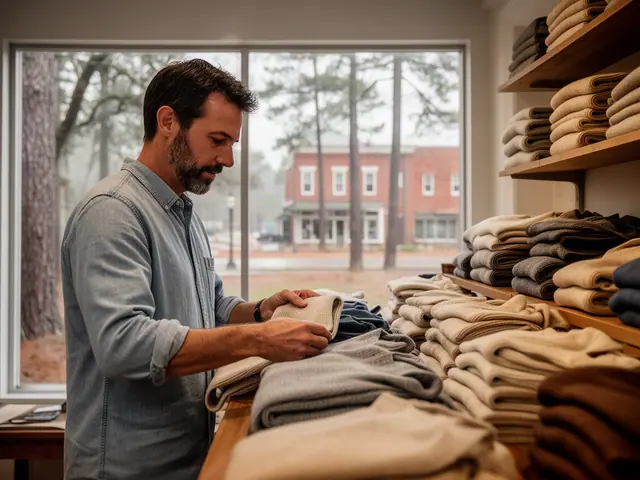
Boutiques finance inventory with supplier terms first, then an inventory loan or a business line of credit paid down as the stock sells. Fixtures and a POS system go on equipment financing, and a second storefront or a shop purchase on a term loan.
An article from Elmgate Lending in Opelika, Alabama on how boutiques pay for stock, fixtures and expansion, with Lee County, AL Census counts for clothing and accessories stores and two invented examples.
Small Business Loan for Boutique Explained With a Lee County, AL Retail Shop Buying POS Systems
A small business loan for a boutique works well when it is matched to the thing it buys. Stock that sells within a few months fits an inventory loan or a credit line. A point-of-sale system, display cases and racks, which last for years, fit equipment financing. A second storefront or buying another shop fits a term loan.
Illustration only, invented figures: a $7,500 point-of-sale package with card readers, a receipt printer and an inventory scanner, financed at an annual rate of 10% over 36 months, would cost about $242 a month (our arithmetic). A system that tracks what sells is also the most useful record a boutique can bring to an inventory request.
Clothing and Accessories Stores in the Lee County, AL Counts
County Business Patterns counted 70 clothing and clothing accessories stores with paid employees in Lee County, AL for 2023, with 765 paid employees between them; 50 of the 70 were clothing stores, and 28 had a ZIP 36801 address. Retail trade as a whole had 533 employer establishments in the county, more than any other sector.
Nonemployer Statistics, a separate program, counted 150 clothing and accessories retailers without paid employees in the county for 2024. Those are counted on their own and not added to the employer figure.
An Invented Boutique Order: Inventory Loan Versus Credit Line
Illustration only, invented figures. A boutique places a $24,000 order for a new line. On an inventory loan at an annual rate of 12% over 6 months, the payment would be about $4,141 a month and the payments would total about $24,847 (our arithmetic). The inventory loan is repaid on that schedule whether the line sells in two months or five.
On a credit line at an annual rate of 12%, the same $24,000 drawn and paid back in full after 75 days would cost about $592 in interest (our arithmetic, simple daily interest), plus any line fees. If the line sells slowly, the balance and the interest stay out longer.
| Item | Inventory loan | Credit line |
|---|---|---|
| Amount | $24,000 | $24,000 |
| Cost in the illustration | $847 | $592 plus line fees |
| How it goes back | 6 fixed monthly payments | Paid down as stock sells |
Retail Store Business Loan Requirements: Display Cases and Holiday Inventory
Requirements for a retail store loan follow the general pattern, with a few retail-specific records. Partners read bank statements for deposit patterns, the latest tax return, point-of-sale reports showing sales by category and month, and supplier invoices. For display cases, add the vendor quote. For holiday inventory or any stock bought ahead of a planned busy stretch, add last year's sales for the same stretch.
- Business bank statements covering the months a partner asks for.
- Sales reports by category and month.
- Supplier invoices and terms.
- The vendor quote for fixtures.
How to Buy a Boutique? What Lee County, AL Retailers Weigh Before a Second Storefront
Buying a boutique, or opening a second storefront, is a bigger step. A buyer reads the seller's tax returns, sales reports, inventory count and lease. Inventory can be counted at closing and priced separately from the rest of the business, and a buyer should know how slow-moving stock is valued before agreeing to a price.
A second storefront adds a lease, a build-out, fixtures and opening stock. The first store's sales history is the main evidence a partner reads. Business term loans covers purchases and expansions.
Working Capital for Retail Stores When an Opelika, AL Retail Shop Needs Security Systems
Security cameras, alarms and access systems are equipment and fit equipment financing. Working capital for a retail store covers something else: payroll, rent and stock in the weeks before sales catch up. A shop installing a security system after a loss may need both: the system on an equipment agreement and a short credit line while stock is replaced.
Inventory financing explains stock-backed money, and equipment financing covers fixtures and systems.
A Boutique Owner's List Before Asking for Inventory Money
- Sales by category and month for the past year, from the POS system.
- The order you want to fund, with the supplier's terms.
- How long similar orders took to sell through.
- Bank statements and the latest tax return.
- Any loans, leases or advances already on the books, with payments.
Retail store loans, grocery store loans and the Opelika, AL business page go further. Bring the order to a call at (334) 336-5822, or enter the ranges on the online form.
By Elmgate Lending · Updated